



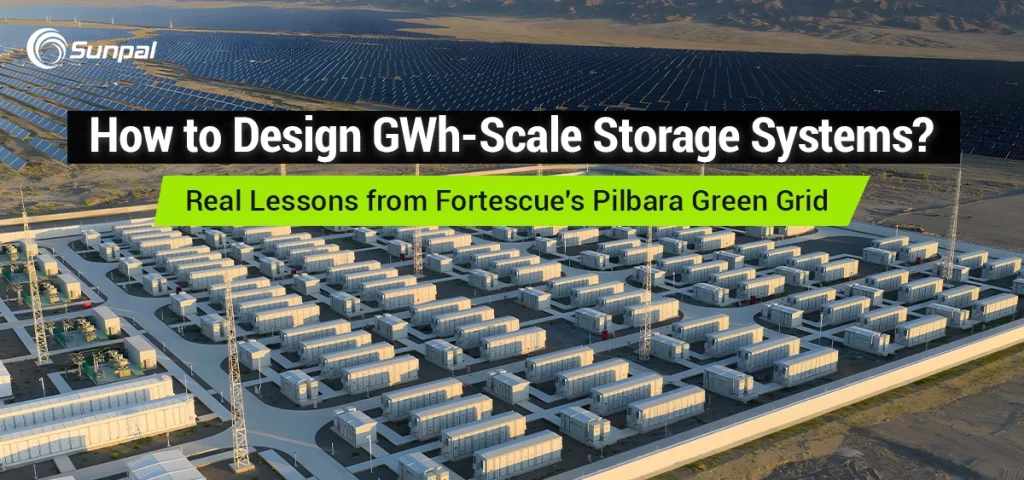
In the remote, sun-scorched Pilbara region of Western Australia, mining giant Fortescue is engineering what it calls the world's largest off-grid renewable energy system dedicated to heavy industry. This ambitious Pilbara Green Grid combines 1.2 GW of solar PV, over 600 MW of wind generation, and a staggering 4–5 GWh battery energy storage system (BESS). Targeted for full operation by 2028, the project will deliver reliable, dispatchable clean power around the clock to iron ore mining and processing operations — slashing diesel and gas dependence while advancing the company's Real Zero emissions goal by 2030.
This isn't just another renewable project. It represents a blueprint for GWh-scale BESS in off-grid and microgrid applications, particularly for mining and heavy industry. Remote sites with continuous high loads, extreme environments, and decarbonization mandates make large-scale energy storage essential. This article distills the key lessons from Fortescue's project, explores design principles, technical challenges, and actionable strategies for developers, EPC contractors, and industrial operators planning similar transformations.
The Fortescue Pilbara Green Grid: A New Benchmark for Industrial Decarbonization
Fortescue's Pilbara Green Grid stands as a pioneering effort to create a fully islanded, industrial-scale microgrid spanning hundreds of kilometers across its iron ore operations. The project integrates massive renewable generation with enormous battery storage to provide 24/7 reliable power, replacing traditional diesel and gas generators that have long powered remote mining activities.
Key project specifications include approximately 1.2 GW of solar capacity, more than 600 MW of wind generation, and 4–5 GWh of total BESS capacity. The system features extensive high-voltage transmission infrastructure, reportedly around 620 km of lines, to connect multiple mine sites, processing facilities, rail, and port operations. Fortescue has accelerated the timeline, with full completion targeted for the end of 2028 — ahead of its original 2030 net-zero ambitions.
Early deployments demonstrate real progress. The company has already installed a 250 MWh BESS at North Star Junction using 48 containers from BYD, delivering 50 MW for five hours. Additional systems, such as a 120 MWh installation at Eliwana and a 650 MWh project at Cloudbreak, are advancing. These initial phases support daytime green processing and are paving the way for full 24-hour fossil-free operations by late 2027.
The significance of this project extends far beyond Fortescue. It proves that GWh-scale storage can firm variable renewables sufficiently to meet the demanding, continuous loads of heavy industry. For mining operators facing volatile fuel prices, logistical challenges in remote areas, and increasing pressure from investors and regulators on emissions, such integrated systems offer a viable path to energy security, cost reduction, and deep decarbonization. By showcasing a replicable model, Fortescue positions itself not only as a mining leader but potentially as a provider of green grid solutions to other industries worldwide.
Roadmap to the World's Largest Off-Grid Industrial Energy System
Fortescue Renewable Energy Transition Timeline (2025–2028)
🌎 World’s Largest Off-Grid Industrial Energy System
Foundation Build
Expansion Phase
System Integration
Global Benchmark System
🔋 Cumulative BESS Growth Pathway
⛽ Diesel Displacement Trajectory
Full-scale renewable system enables elimination of 200–250 million liters of diesel per year.
Core Lessons: Key Design Principles for GWh-Scale Off-Grid Storage
Designing a GWh-scale battery energy storage system for off-grid industrial use requires careful attention to several interconnected principles. Fortescue's approach offers valuable insights applicable across the mining and heavy industry sectors.
Energy Capacity, Duration, and Load Matching
The foundation of any successful system is precise load profiling. Mining operations typically feature steady, high baseload demand from crushers, conveyors, pumps, and processing plants, with occasional peaks. Fortescue's design emphasizes multi-hour to daily cycling, targeting 4–8+ hour duration storage to bridge solar generation gaps during evenings and periods of lower wind output.
Best practices include combining solar and wind resources for improved overall capacity factors. In the Pilbara's sunny but variable climate, solar might achieve 25–30% capacity factors, while wind provides valuable complementarity. Developers should use years of historical weather, production, and load data for robust modeling. Over-sizing energy capacity relative to power output ensures resilience against extreme weather or unexpected demand spikes.
System Architecture and Seamless Integration
A robust industrial microgrid demands advanced architecture. Grid-forming inverters are essential for maintaining stability in weak or islanded networks, unlike traditional grid-following systems. High-voltage transmission minimizes losses over long distances, while sophisticated Energy Management Systems (EMS) with AI-driven forecasting, real-time optimization, and automated dispatch become the brain of the operation.
Hybrid integration with legacy gas or diesel generators allows a smooth transition phase and provides emergency backup. Containerized BESS solutions are particularly advantageous due to their factory-tested, plug-and-play design, enabling rapid deployment and future expansion. This modular “Lego-like” approach supports seamless scaling without major system redesigns.
Battery Technology Selection: Why LiFePO4 Dominates Industrial Applications
For harsh industrial environments, LiFePO4 (LFP) chemistry has emerged as the leading choice for large-scale projects. Its advantages include superior thermal and chemical stability, which dramatically reduces thermal runaway risks compared to other lithium-ion variants. LFP batteries typically deliver 3,000–6,000+ cycles at high depth of discharge, making them ideal for daily industrial cycling. They also perform well in high-temperature and dusty conditions with appropriate thermal management.
Containerized LFP systems offer excellent scalability, inherent safety certifications, and lower long-term maintenance needs — critical factors for 24/7 mining operations where downtime carries enormous costs. While other chemistries may offer higher energy density, LFP's balance of safety, longevity, and cost-effectiveness aligns perfectly with stationary, long-duration storage requirements in remote heavy industry settings.
Industrial BESS Chemistry Benchmark (2026)
LiFePO4 vs NMC vs NCA — safety, lifecycle, cost & performance comparison
Source: 2025–2026 global BESS industry benchmarks
Scalability and Phased Deployment Strategies
One of the strongest lessons from Fortescue is the power of phased implementation. Starting with 250 MWh and 650 MWh clusters before scaling to multi-GWh allows operators to manage capital expenditure, de-risk technology choices, and incorporate operational learnings into subsequent phases. This strategy improves cash flow, delivers early emissions reductions and cost savings, and builds stakeholder confidence.
Reliability, Redundancy, and Operational Resilience
Heavy industry cannot tolerate interruptions. Designs must incorporate N+1 or greater redundancy, advanced climate control, dust and corrosion protection, and comprehensive fire detection and suppression systems. Black-start capabilities and seamless islanding functionality ensure rapid recovery from disturbances. In cyclone-prone or extreme-heat regions like the Pilbara, structural resilience and redundant cooling systems are non-negotiable.
These principles, when applied holistically, transform variable renewables into reliable, dispatchable industrial power sources.
Overcoming Technical and Operational Challenges — and Solutions
Large-scale off-grid BESS projects face significant hurdles, but Fortescue's progress highlights effective mitigation strategies.
Environmental extremes pose major challenges. High ambient temperatures require sophisticated liquid or air cooling systems to maintain battery performance and lifespan. Dust and sand ingress demand high IP-rated, sealed enclosures and regular maintenance protocols. Fire safety demands proper container spacing, continuous monitoring, aerosol or other suppression systems, and rigorous risk assessments.
Economic considerations include high initial CAPEX, though rapidly declining battery prices and substantial diesel displacement deliver attractive ROI — often within 5–7 years in high-fuel-cost remote sites. Phased deployment helps align investment with savings and financing availability. Supply chain management for such massive projects requires early planning and diversified sourcing.
Grid stability in off-grid environments relies on modern inverters providing synthetic inertia, frequency regulation, and voltage support. Advanced EMS platforms are crucial for predictive control and optimization across the entire microgrid.
Maintenance strategies benefit from remote monitoring, predictive analytics using AI, and modular component designs that allow hot-swappable repairs. Lifecycle planning should address battery degradation, augmentation strategies, and eventual recycling or second-life applications to enhance sustainability and economics.
Diesel/Gas vs GWh-Scale BESS + Renewables
Industrial energy system comparison (2025–2026 remote mining benchmarks)
BESS + Renewables consistently outperform diesel systems in cost stability, emissions, and scalability.
Broader Applications and Opportunities for Mining & Heavy Industry
The Fortescue model has wide relevance beyond iron ore. Similar approaches can power copper, gold, lithium, and other mining operations in remote regions of Africa, South America, and Asia. The principles also extend to large industrial parks, islands, and even data centers seeking greater energy independence and resilience.
Emerging synergies include pairing storage with electrified mining fleets (such as battery-electric haul trucks) and green hydrogen production for further decarbonization. Policy support — including carbon pricing, renewable energy mandates, and green financing — continues to strengthen the business case.
Global battery storage markets are expanding rapidly, with industrial and mining segments gaining momentum as technology matures and costs fall. This creates substantial opportunities for project developers, EPC contractors, equipment suppliers, and service providers who can deliver bankable, integrated solutions at scale.
Global Mining Regions Poised for GWh-Scale Off-Grid Storage
Interactive map of high-potential mining electrification zones (Solar + BESS + Wind)
Based on remote mining electrification demand (2026 estimates)
Actionable Recommendations: How to Design Your Own GWh-Scale Project
Successfully replicating elements of the Fortescue model requires a structured approach:
- Perform comprehensive site assessment, including detailed load profiling, renewable resource analysis, environmental conditions, and future expansion forecasts.
- Develop robust techno-economic models to optimize system sizing, calculate levelized costs, and evaluate multiple scenarios.
- Prioritize modular, safety-focused technologies such as proven LiFePO4 containerized systems with strong integration track records.
- Adopt phased deployment to achieve early wins and manage risk.
- Invest heavily in advanced EMS, grid-forming inverters, and comprehensive control systems.
- Partner with experienced providers offering bankable products, long-term performance warranties, and local support capabilities.
Future-proof designs by building in expandability for growing loads or integration of emerging technologies.
Planning a large off-grid or microgrid project?
Get our comprehensive GWh-Scale Industrial Storage Planning Guide for detailed checklists, cost models, and technical insights.
📩 Get the Planning GuideResponse via WhatsApp within 24 hours
Conclusion
Fortescue's Pilbara Green Grid demonstrates that GWh-scale off-grid energy storage is not only technically feasible but economically and environmentally transformative for mining and heavy industry. By intelligently combining massive renewables with safe, scalable, and intelligent BESS, operators can achieve deep decarbonization, significant cost savings, and superior energy security.
The core lessons — prioritizing safety and longevity with LiFePO4, embracing modularity, investing in sophisticated controls, and designing for real industrial demands — provide a clear roadmap. As battery technology advances and costs continue declining, these systems will become the industry standard.
The era of large-scale green industrial power is here. Now is the time for mining and heavy industry leaders to act.
Ready to develop your GWh-scale storage solution? Contact Sunpal's industrial energy storage specialists for tailored system design, product recommendations, and project support. Explore our containerized energy storage systems and LiFePO4 battery solutions engineered for large-scale, off-grid reliability.